
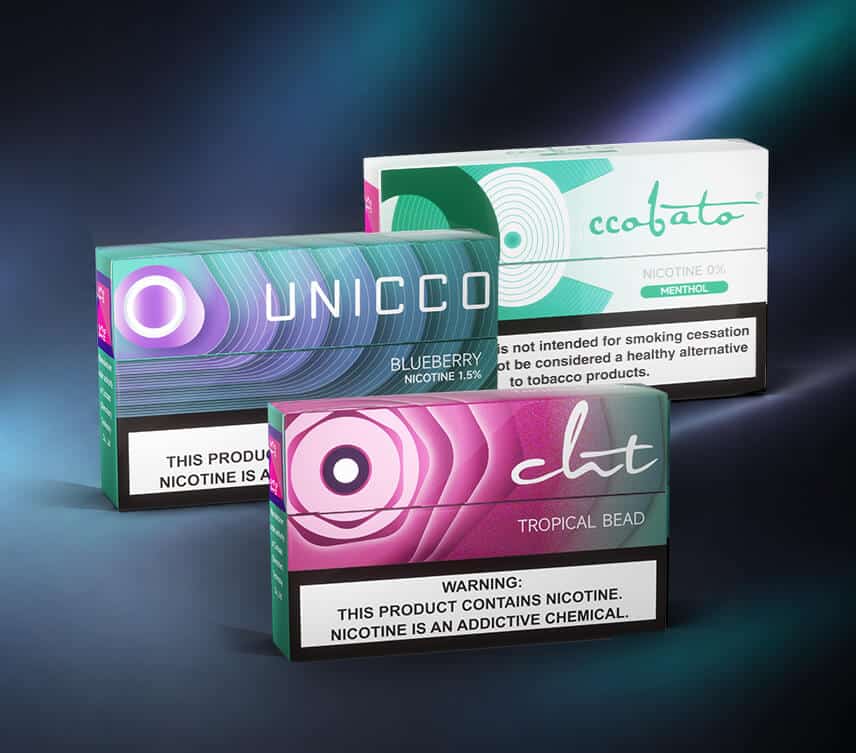
The direct answer: seven manufacturers, four dimensions
Here is the direct answer. Seven manufacturers define HNB stick supply: Philip Morris International, British American Tobacco, Japan Tobacco Inc. (JTI), Imperial Brands, KT&G, Smoore, and Ccobato, our company. We fix the roster and organize it on four dimensions we built for this article: capacity and consistency, compliance and certification, patent and FTO risk, and OEM and channel relationships. The framework is ours, not an industry standard; it falls out of what a stick is.
Start from what a stick is. An induction stick carries an elongate susceptor lengthwise inside its aerosol-forming substrate, and the device’s coil couples with that susceptor to heat it from the inside [1]. That geometry produces two of the four dimensions. Every stick in a run of billions must repeat the same electromagnetic response, and the FDA’s proposed manufacturing-practice rule exists to minimize contamination and ensure product consistency [2]; capacity and consistency fail or pass together. The same geometry sits inside a patent family still producing fresh US grants as of August 2025 [1], so patent and FTO risk decides whether a maker can sell at all.
The other two dimensions follow from how sticks reach shelves. Compliance and certification is a documentation check: the approvals each maker’s sticks carry into each market, reported where published. OEM and channel relationships exist because most capacity is contractually closed. PMI commercializes KT&G’s devices and consumables on an exclusive, worldwide basis outside South Korea [3], and Smoore’s listed HNB revenue rides one strategic customer’s launch [4]. Buyers need the channel map before they need the spec sheet.
The seven sort into three roles: five international tobacco companies, one listed contract manufacturer, and one independent maker of compatible and herbal series. The order follows the roles rather than capacity or buyability. We excluded some Chinese HNB OEM/ODM stick makers on purpose. Pantents, channel role, scale tier, and disclosure transparency keep them off this roster. The transparency gap is concrete: unlike every name we kept, they publish no statutory filings a buyer can check capacity, certification, or patent claims against, so the due-diligence burden lands entirely on the buyer. We will not dress that qualitative call up as a metric.
Now the line that drives everything after this: the manufacturers you recognize are mostly the ones you cannot buy from.
The catch: the biggest names are the ones you cannot buy
You know the brands. You cannot buy the sticks. The reason is not a missing distributor list; it is engineering first, contract second.
Take JTI’s EVO. It says the sticks were “crafted exclusively to be used with Ploom AURA” and “optimized for our unique heated tobacco technology, HeatFlow” [5]. The stick is tuned to one heater’s protocol and thermal profile: the device is the razor, the stick is the blade. Such a stick works only inside its own platform.
Then contracts close what engineering left open. PMI’s agreement with KT&G covers “devices and consumables on an exclusive, worldwide basis (excluding South Korea)” [3]. The word consumables is the tell: sticks and devices are one commercial unit. Beyond those clauses, we found no public supply channel where any major wholesales sticks; we state what we could verify, not that none can ever exist.
Two evidenced paths remain, each asking a different engineering capability. OEM manufacturing builds sticks to a brand’s spec: Smoore’s filing ties its HNB revenue to a “strategic customer” rolling out premium HNB products [4]. Compatible sticks build to an existing platform instead, which is our business: HNB sticks compatible with electromagnetic induction devices, our patent portfolio cleared through FTO analysis.
Five of the seven names are closed to you. Two will take your inquiry.
| Closed, self-supplied | Open to inquiry |
|---|---|
| PMI (TEREA, HEETS) | Smoore (OEM sticks, enterprise scale) |
| BAT (glo sticks) | Ccobato HNB (compatible and private label) |
| JTI (EVO) | |
| Imperial Brands (iD, iSenzia) | |
| KT&G (Fiit) |
Table notes: JTI and KT&G are closed by official exclusivity [5][3]; PMI, BAT, and Imperial show no public wholesale channel found. Smoore’s door is open at enterprise scale, not for small and mid-size buyers. Your real candidate pool has two names, not seven.
Pick the platform first, then the supplier
Sticks are not generic consumables. Each device platform locks its sticks, so the platform you buy for decides the supplier you can buy from. TEREA embeds a stainless-steel-coated metal heating element inside the stick that heats the tobacco from within [6][7]. EVO is exclusive to Ploom AURA [5], and JT positions EVO as the global sticks brand that complements Ploom’s heating technology [8]. KT&G’s Fiit sticks travel with the lil devices under the PMI deal [9]. glo devices are built around their own specially designed consumables, and they accept nothing else [10].
That is why our advice to buyers inverts the usual order. Do not start with a supplier list. Start with the platform: which device will your customers already own, and whose sticks does it accept? If the answer is IQOS ILUMA, your options are the official TEREA channel or a compatible stick. Compatible sticks buy you exactly one thing: the customer keeps the device and changes the consumable source. That value has an engineering price. An induction device talks to the stick’s embedded susceptor through a specific protocol, so a compatible stick has to match that protocol and carry its own susceptor. Platform first, then supplier.
PMI: the standard-setter you cannot buy from
PMI defines what a stick is, and you cannot buy its sticks. It runs two stick generations: HEETS for blade-heating devices, TEREA for IQOS ILUMA’s induction system. The manufacturing difference between them is the heating element inserted into the tobacco plug inside the TEREA stick [11]. The shared line: tobacco leaves ground and reconstituted into cast leaf, mixed with water, glycerin, fibers and guar gum into a slurry, cast into sheets, cut, and packed 20 to a hinge-lid box [11].
Skip the adjectives; read the numbers. In Japan, IQOS holds close to 70% of HNB category volume, and in December 2025 the HNB category passed 50% of total nicotine offtake nationally [12]. HTP use rose fast from 2015 to about 2019, then slowed through 2023 [13]. For single-market scale, PMI’s own disclosure is stark: it canceled plans to make more than 20 billion TEREA sticks in Russia, plus USD 150 million of related investment [14].
One health line we keep consistent: heated products emit lower levels of harmful ingredients than cigarette smoke, but “that does not mean heated tobacco products are safe” [15]. Harm-reduced is not harmless.
For a buyer, PMI matters as the standard-setter and the reference point of the patent picture. Any compatible-stick decision has to answer for its relationship to PMI’s patent families.
BAT: a £1bn brand whose latest sticks are made elsewhere
glo is a £1bn brand, one of two BAT has built [16]. Officially, the platform runs on two consumable types: “specially designed tobacco and herbal consumables” heated to a set temperature [10].
And here is the fact that should reshape how buyers think about contract manufacturing: BAT’s latest HNB product has its sticks made by an external manufacturer. To be precise about sourcing: it is our first-party understanding, not a public disclosure, that Smoore OEM-manufactures those sticks. What Smoore’s filing states publicly is narrower: HNB revenue grew on “support of its strategic customer in rolling out premium HNB products in the second half of 2025” [4]. No BAT source publicly names its stick OEM; the industry habitually does not disclose this. We keep the two tracks separate on purpose.
The lesson for buyers: when a top-five tobacco company outsources its newest stick generation, “OEM” is not a downgrade. It is where the category is heading.
JTI: Ploom AURA and the EVO lock-in
JTI launched Ploom AURA and its EVO sticks in Japan on 27 May 2025 [8]. The same release declared EVO “JT Group’s global heated tobacco sticks brand” [8]. A stick for one device, a brand for every market.
For a buyer, the question that matters sits on Ploom’s own FAQ: “Can I use Ploom tobacco sticks with other heated tobacco products?” [5] JTI’s reply is an engineering statement: EVO sticks “are not designed to be used with other heated tobacco devices” [5]. That answer closes JTI’s stick volume inside the Ploom platform.
JTI said Ploom AURA “will roll out globally in the near future” [8]. A global device rollout pulls stick demand behind it: each new market adds EVO volume that someone has to make, in-house or through an OEM. The lock-in shrinks the compatible lane and feeds the manufacturing one.
Imperial Brands: still operating, limited scale, concentrated markets
Imperial is the entry most guides get wrong. Its heated tobacco business is still operating: the April 2026 pre-close update reports “continued momentum in heated tobacco with Pulze 3.0, particularly in Italy and Greece” [17], the only two markets it names. It gives no volume or share figures; the brand page scopes the lineup to “several markets across central, eastern and southern Europe” [18].
Pulze pairs with iD heated tobacco sticks and iSenzia, “flavoured zero tobacco sticks” [18], Imperial’s “nicotine tea sticks” [18] range. Within Imperial’s portfolio, iSenzia is an established product line, not a pilot.
For buyers, this entry is a market map, not a supplier. If Italy or Greece is your target market, a tobacco major already sells zero-tobacco sticks there: the regulatory and retail path is proven, and iSenzia is the benchmark your product will be measured against.
KT&G: the maker that split manufacturing from selling
If you distribute in Eurasia, you have seen Fiit sticks on shelves, made by KT&G, sold by PMI. A January 2023 agreement hands PMI the commercialization of KT&G’s “devices and consumables on an exclusive, worldwide basis (excluding South Korea)” [3]. One company makes; the other sells, everywhere but South Korea.
The rollout works in stages: lil SOLID 1.0 opened Russia and Ukraine, and lil SOLID 2.0 with Fiit reached four Eurasian markets in Q2 2021 [9]. Fiit comes in seven types, three or four per country “depending on the market situation” [9]. What your market stocks is a joint merchandising call, not KT&G’s alone.
Read the deal like a buyer. Exclusivity here carries volume commitments set every three years, expected to grow over the full term [3]. KT&G’s stick capacity is sold forward to one customer.
The “closed” column has two structures: a maker that sells, and a maker that rents its volume to a seller. KT&G proves the second works. When you screen suppliers, ask which side a factory offers you.
Smoore: the only pure manufacturer on the list
Smoore is the only name on this list with no HNB consumer brand of its own. It makes; others sell. Its Hong Kong filing is the public dashboard for that business: HNB products and technical services brought in approximately RMB664.0 million in the period ended 31 March 2026, up 1324.9% year on year, a jump the filing attributes to “support of its strategic customer in rolling out premium HNB products in the second half of 2025” [4]. A single customer launch, read through a legal disclosure: that is what a stick OEM ramp looks like.
The pool it feeds is on record too. Smoore’s annual report cites the Sullivan Report: global retail sales of HNB sticks reached about 204.1 billion units in 2025, with roughly 11.5% compound growth projected to 2030 [19]. On that evidence, Smoore is one of the leading contract manufacturers in the category. We write “one of the leading,” not “the leader,” because the filings support the former.
Ccobato: a supplier of electromagnetic induction-compatible HNB sticks that you can truly work with
We are the seventh entry, and the one whose whole model is taking your inquiry. We build electromagnetic induction-compatible HNB sticks, which makes our standing in this list answerable to the same three tests we tell buyers to use: device compatibility, patent safety, and flavor range.
Device compatibility is the first test. Our sticks are engineered for electromagnetic induction system, the one where the device heats a stainless-steel-coated element inside the stick [6][7]. On our side, that means our own Ultra-Microcellular Technology and in-house susceptor materials. Our recognition rate runs at 90%–100% by our own testing; treat that as our claim, not an industry benchmark.
Patent safety is the second test, and it is where context matters. A patent ruling stopped IQOS imports in the US in 2021 [20], and the base induction-stick architecture keeps generating grants, with US patents still issuing in August 2025 [1]. Herbal and tea-based sticks are patented engineering in their own right [21]. We position our portfolio as patent-safe because we run FTO analysis on it: 30+ invention and PCT patents cleared through that process. Ask to see the analysis. Any supplier making a patent claim should be able to show the work.
Flavor range is the third test. Four series: tobacco-based sticks, nicotine herbal with tobacco flavor, nicotine herbal with vape-style flavor, and zero-nicotine herbal, the last built for markets that restrict nicotine. One supplier, three lines covering all three compliance classes a buyer might need.
Three practical notes. We sell to businesses only; no consumer sales, no consumer samples. Our compliance and certification record for supplier-side comparison: MSDS, JFRL, ISO 9001, ISO 14001, and GMP, with products notified under the EU Tobacco Products Directive (TPD).
The tobacco-free and herbal lane is real
Tobacco-free sticks are not a side project. Three independent layers of evidence say the lane is real.
The majors run it. BAT’s official glo page names “specially designed tobacco and herbal consumables” [10]. Imperial Brands sells iSenzia, a flavoured zero-tobacco stick, alongside its tobacco iD sticks [18].
The patents describe how to build it. A published herbal HNB application specifies raw materials from herbal spice or Chinese medicine: tea, lotus leaf, mint, licorice, and clove among them. Glycerol at 30–60 parts, raw material pre-ground and sieved through 40–200 mesh, volatilizing at 200–300°C [21]. Trade press sketches the same recipe from the market side: black tea leaves as the carrier, infused with aromas, with or without nicotine, used in regular tobacco-heating devices [22].
Regulators are already naming the category. The EU’s tobacco taxation review proposes extending the directive to new products, heated tobacco among them, with new minimum taxes [23]. A patented, major-brand, taxably defined product line is not an experiment.
The engineering should not surprise anyone. A tobacco-free stick runs on the same kind of cast-and-form line as a tobacco stick: the carrier changes, the process does not. The slurry line we described for electromagnetic induction-compatible HNB sticks applies here too.
Tobacco content, not brand size, decides your compliance risk
Is a zero-tobacco stick a tobacco product? In the EU, the line is one definition: “tobacco products” means products that “consist, even partly, of tobacco” [24]. Add a trace of tobacco to a herbal stick and the whole stick becomes a tobacco product. That is why we tell buyers: tobacco content determines compliance risk more than brand size does. A stick from a small factory containing tobacco faces tobacco regulation; a stick from a giant containing none may fall outside it. The same factory can run three sticks that land in three regulatory classes.
The classification gap is closing on both sides. The EU’s taxation review proposes bringing heated tobacco and other new products into the directive with minimum taxes [23]. In the United States, tariff heading 2404 already sweeps products “whether or not containing nicotine, intended for inhalation without combustion” into one chapter [25]. Herbal smoking products have been under EU tobacco law since 2016 [26].
For a sourcing decision, this is practical. Formulation is a compliance decision: choose the tobacco line or the herbal line knowing which regulatory, tax, and tariff lane each one runs in. Brand size will not save you from that choice.
Patent risk: when a ruling, not a rival, stops your sticks
Here is the clearest patent fact in the category: on 29 November 2021, the US International Trade Commission ruled that the IQOS device infringed the patent rights of a rival tobacco company, and US imports and sales of IQOS stopped [20]. A ruling halted the flagship product of the category’s standard-setter in one of the world’s largest markets. PMI was the defendant; no major vendor is immune.
How do giants manage this friction? By contract. PMI and BAT settled all of their heated tobacco and vapor patent litigation globally in February 2024 [27][16]. The SEC filing puts the structure on record: an eight-year term from 1 February 2024, worldwide in scope [28], with covenants not to sue covering the manufacture of products, accessories, replacement parts, and components [28]. Eight years of mutual restraint, in writing.
The patent family presence around induction sticks keeps growing. The base architecture, a stick with a susceptor running lengthwise inside the substrate, produced a new US grant as recently as August 2025 [1]. We avoid calling PMI’s portfolio a wall; a broad family presence is the phrasing the record supports.
Your action item is boring and cheap. Ask every stick supplier for an FTO (Freedom to Operate) opinion covering your target markets, and check its date. We recommend this as a due-diligence step based on how this category has actually played out, as of August 2026; it is not a legal guarantee in either direction.
The OEM shift: brands are separating from manufacturing
The stick business is moving from self-manufacture to outsourced OEM. The overall pool is growing at a double-digit rate: 204.1 billion sticks at retail in 2025, projected at roughly 11.5% compound growth through 2030 [19]. Smoore’s quarterly HNB revenue is up 1324.9% on a single strategic customer’s launch [4]. Together, those two lines describe a market where demand is broad and manufacturing is concentrating.
Two roadmaps follow for a brand owner. One: contract an OEM to build your sticks to your spec. Two: take compatible or private-label sticks and put your brand on them. The supplier question is downstream of that choice.
Best fit beats biggest. The right stick manufacturer for your launch is the one that matches your device platform, channel model, and brand route. There is no single global answer to “best manufacturer”; there is a best fit per project.
How to start a stick-sourcing project
The next move takes half an hour: send an inquiry.
Ours is strictly B2B: an inquiry form, free samples, and business meetings by appointment, none of it open to consumers.
After first contact, the published flow: we evaluate your requirements, develop flavors, send free samples, support certifications, move to mass production, and deliver. NDA and IP protection are signed before details start; the engagement runs as a complete or partial turnkey.
Our published numbers: samples to small batch in 1–2 months, mass production in 4–6 months. The white-label minimum is described only as small, with no number attached. Pricing is quotation-only; get the actual MOQ from the quote, in writing.
Unstated: who covers sample freight, duties, and clearance, and how long shipping to your market takes. Ask both in the inquiry.
Contact: our site form or email us, at Room 705-708 Meizhou Building, No40-12 Longzhu Avenue, Nanshan District, Shenzhen, China.
References
[1] WO2017153443A1 – Aerosol-generating article with elongate susceptor (Philip Morris Products SA). https://patents.google.com/patent/WO2017153443A1/en
[2] FDA Proposes New Requirements for Tobacco Product Manufacturing Practices (8 March 2023). https://www.fda.gov/news-events/press-announcements/fda-proposes-new-requirements-tobacco-product-manufacturing-practices
[3] PMI Announces Agreement to Extend and Deepen Collaboration With KT&G (29 Jan 2023). https://www.pmi.com/investor-relations/press-releases-and-events/press-releases-overview/press-release-details?newsId=25886
[4] Smoore International Holdings Limited: Financial Update for the Period Ended 31 March 2026 (HKEX announcement, 9 April 2026). https://www1.hkexnews.hk/listedco/listconews/sehk/2026/0409/2026040902236.pdf
[5] Can I use Ploom tobacco sticks with other heated tobacco products? | Ploom (JTI). https://www.ploom.jo/en/support/faq/can-i-use-ploom-tobacco-sticks-on-other-device
[6] Terea Smartcore Sticks explained (PMI official glossary). https://www.pmi.com/glossary-section/glossary/terea-smartcore-sticks
[7] Smartcore Induction System FAQs | IQOS. https://www.iqos.com/aw/en/get-support/faqs/smartcore-induction-system.html
[8] JT Group Launches Ploom AURA and EVO Heated Tobacco Sticks in Japan (27 May 2025). https://www.jt.com/media/news/2025/0527_E01.html
[9] KT&G’s Smoke-Free Product ‘lil SOLID 2.0’ Being Commercialized in 4 Countries in Eurasia (15 June 2021). https://en.ktng.com/media/news/press-release/detail/13453
[10] glo | British American Tobacco. https://www.bat.com/brands-and-innovation/glo
[11] Manufacturing the tobacco sticks in our Tobacco Heating System and Oven Heating System (Scientific Update Issue 17R). https://www.pmiscience.com/en/news-events/scientific-update-magazine/manufacturing-the-tobacco-sticks-/
[12] Philip Morris International Reports 2025 Fourth-Quarter & Full-Year Results (6 Feb 2026). https://www.pmi.com/investor-relations/press-releases-and-events/press-releases-overview/press-release-details?newsId=29566
[13] Recent Trends in Cigarette and HTP Use in Japan: A Scoping Review (Nicotine & Tobacco Research, 2026). https://pmc.ncbi.nlm.nih.gov/articles/PMC13008579/
[14] Philip Morris International Inc. (PMI) Announces Concrete Steps to Scale Down Operations in the Russian Federation and Its Intention to Exit the Market. https://www.pmi.com/media-center/press-releases/press-details?newsId=25011
[15] Heated Tobacco Products. https://www.cdc.gov/tobacco/other-tobacco-products/heated-tobacco-products.html
[16] BAT and PMI Announce Global Patent Settlement. https://www.bat.com/DOD23CX6.html
[17] Pre-close trading update HY26 – Imperial Brands (14 April 2026). https://www.imperialbrandsplc.com/news/key-announcements/2026/pre-close-trading-update-hy26
[18] Our brands | Imperial Brands. https://www.imperialbrandsplc.com/our-brands
[19] Smoore International Holdings Limited: Annual Report 2025. https://smooretech.oss-cn-shenzhen.aliyuncs.com/en/uploads/2025AnnualReport_1780968129.pdf
[20] Anticipating IQOS market expansion in the United States. https://www.tobaccopreventioncessation.com/Anticipating-IQOS-market-expansion-in-the-United-States,144650,0,2.html
[21] Heat-not-burn aerosol-generating article, product and manufacturing method thereof – Google Patents.
[22] Teatime: Sales of herbal heated-tobacco sticks are growing in Europe (Tobacco Reporter, 1 Aug 2023). https://tobaccoreporter.com/2023/08/01/teatime/
[23] Revision of the Tobacco Taxation Directive – Taxation and Customs Union, European Commission. https://taxation-customs.ec.europa.eu/review-excise-duties-tobacco_en
[24] Directive 2014/40/EU (Tobacco Products Directive), consolidated text 23.10.2023. https://eur-lex.europa.eu/legal-content/EN/TXT/?uri=CELEX%3A32014L0040
[25] Harmonized Tariff Schedule of the United States Revision 16 (2026), Chapter 24: Tobacco and Manufactured Tobacco Substitutes. https://hts.usitc.gov/reststop/file?release=currentRelease&filename=Chapter%2024
[26] EU-CEG reporting obligation for herbal smoking products | Office for Tobacco Coordination, Austria. https://www.tabak.gv.at/en/eu-ceg/eu-ceg-reporting-obligation-for-herbal-smoking-product
[27] PMI and BAT Announce Global Patent Settlement (2 February 2024). https://www.pmi.com/media-center/press-releases/press-details?newsId=27101
[28] British American Tobacco p.l.c. Form 6-K: Settlement Agreement between Nicoventures Trading Limited and Philip Morris Products S.A. (BAT and PMI Announce Global Patent Settlement). https://www.sec.gov/Archives/edgar/data/1303523/000095015724000101/form6-k.htm